BrainTrain Electrodes
*Won 3rd Place in CSU BME Virtual Engineering-Days competition*
BrainTrain Electrodes is the capstone project that I was a part of during my final year at CSU. My teammates and I submitted the idea as a project proposal to the Walter Scott College of Engineering and we were lucky enough to be selected for funding as an entrepreneurial senior design project. It should also be noted that many components of the project were not completed, as all work had to be halted prematurely due to COVID-19.
BACKGROUND
In recent years, the emergence of noninvasive brain stimulation (NIBS) has gained momentum, as it allows for targeted cortical modulation. Transcranial alternating current stimulation (tACS), a specific NIBS technique, is the process of applying alternating electrical current at a set frequency to interact with the brain's natural cortical oscillations. Underlying cortical oscillations of neurons can be manipulated in a process known as entrainment. If the input sine wave (2mAor below) has a frequency closely matching that of the endogenous brain activity, phase locking will occur, allowing the input frequency to be adjusted, bringing the cortical oscillations with it and altering the user's brain state. Research has suggested that tACS can help improve symptoms of ADHD, Alzheimer's, Parkinson's, and dementia through entrainment of various neuronal groups and improving the working memory of these individuals.
PROBLEM
The main problem with non-invasive brain recording and stimulation products on the market today is the inability to simultaneously read EEG data and write electrical current stimulation. There are no electrodes available that have this ability, which makes most transcranial electrical stimulation (tES) devices on the market relatively ineffective. These devices deliver current without the ability to monitor or modulate the region of interest during stimulation. In order for these devices to be effective, the stimulation needs to be applied for several minutes without interruption. As of now, it is not possible to ensure that the stimulation is effectively altering brain waves as the tES is being administered without stopping the treatment. With the integration of novel BrainTrain electrodes, it will be possible for electrical current stimulation devices to read EEG data while delivering tACS and would give these devices the opportunity to modulate the stimulation in accordance with the EEG, making the treatment much more effective.
GOALS & OBJECTIVES
Goals for this project were broken up into three main categories: Material Development, Hardware Development, and Software Development. I participated mostly in the Material Development and Hardware Development sections, as this is where my skill-set was best suited. The following table provides an overview of the various goals that the team established to achieve each main objective of the project, while the flowchart highlights the methods and processes we carried out to accomplish set tasks.


RESULTS & FINAL CONCEPTS
Material Development
Material testing was a major physical component of the project prior to the introduction of COVID-19 protocols. The primary goals of material testing were to develop a conductive PDMS polymer with considerations for the physical properties of the material. After a long iterative process, a suitable carbon nano-filler was decided upon to incorporate with PDMS to become the material that would be used to create the electrodes.
Electrodes
While creating the physical design of BrainTrain electrodes, several design considerations were kept in mind: surface area contact with the scalp, ease of manufacturability, durability, and the ability to localize the tACS application to the specific region of the brain in which the EEG is reading from. If all of these factors are optimized, the electrode performance would also be optimized. The following design was chosen, as it was determined that it would satisfy all the design considerations best.


Multiple molds of the design were made by modeling and 3D printing its inverse, allowing the group to manufacture many electrodes at once. The outer portion of the electrode makes up the tACS region, the inner portion of the electrode makes up the EEG region, and the middle portion makes up the insulative layer that separates the two domains. Both the tACS region and EEG region were made out of the material that the team developed, while the insulative material was made out of PDMS. Although we were very close to finishing the electrodes, the team was unable to produce a final version with the material that the team developed before all work on the project was halted due to COVID-19. Prototype electrodes were created using only PDMS to test the molds and produce a physical representation of the product, which can be seen below.


Headset
At the beginning of the project, the headset was established as a reach goal once the main components were completed. Fortunately, the design of the headset was completed, as seen in Figure 14, however, the team was unable to finalize a physical prototype of the headset due to COVID-19. The headset houses seven electrodes across the frontal lobe to gain a comprehensive reading of the region that is responsible for functions such as motor control, problem-solving, and memory. The headset was designed to be 3D printed in soft and flexible plastic, such as TPU, which would allow it to expand over different sized heads.

Phantom Head
The phantom head was created in order to determine BrainTrain electrodes' ability to effectively read EEG data and administer tACS. Although it was utilized mostly as a validation tool for the efficacy of the electrodes, it ended up being a large part of the project. Unfortunately, validation testing was not carried out due to COVID-19, however the physical portion for the phantom head was completed, as well as the plan for the testing. To simulate brain activity in the phantom head, two wires would have been threaded up the length of the head and into the gelatin “brain”. EEG data would have been transmitted through the wires and BrainTrain electrodes would have been placed on the surface of the gelatin to determine how effectively they were able to pick up the signal. Because the gelatin was created to have a conductivity that is comparable to that of grey matter, it would have allowed the signal to propagate throughout the “brain”, however, a plastic fin was inserted through the middle of the gelatin to ensure that the signals were forced up to the surface of the gelatin, rather than directly across to the adjacent wire. The electrodes would have also been activated to deliver a small amount of electrical current to the gelatin and the EEG data would have been examined to determine whether the stimulation affected the signal. Through this testing, the team would have been able to test the BrainTrain electrodes’ capability of reading EEG data and administering tACS concurrently.

Software & Hardware
The BrainTrain software and hardware device was developed with maximum system functionality. The hardware encompasses both an EEG system and a tACS system which is easily expandable to additional channels of both signal acquisition and stimulation. The software was developed using open-source cross-platform frameworks. This software and hardware combination was built with the intent to research and develop a closed-loop EEG+tACS system. The GUI was not completed as the hardware components were not finished prior to COVID-19 protocols, however the following screenshot exhibits what the team planned for the GUI would to look like, along with its integrated features.
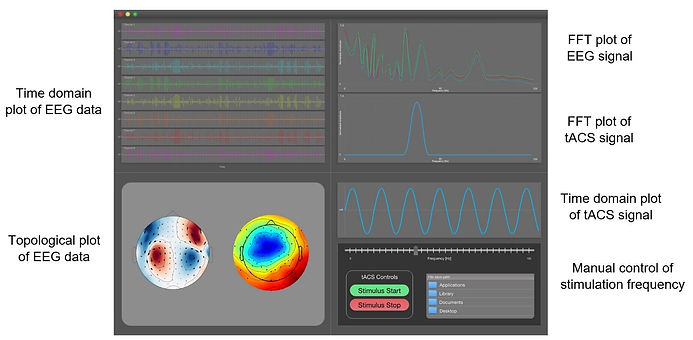
The functional diagram below shows how all the components of the project would have been wired together. It consists of two main subsystems integrated through software - the tACS system for signal generation and application and the EEG system or signal acquisition. BrainTrain electrodes would have been responsible for delivering and acquiring the signals through two regions and the user interface would have allowed for hardware control.

FINAL POSTER
The final poster that my team and I presented virtually for the CSU BME Engineering-Days competition can be viewed below, which gives a brief overview of the information described above. We were honored to be awarded with 3rd place out of all the 2020 Biomedical Engineering projects. Despite the early end to the project, I am proud of how much my team and I accomplished, as well as the variety of engineering principles that we applied and the problems we solved throughout the course of the project.
-page-001.jpg)
For more information about BrainTrain electrodes, check out this website, which was created by one of my teammates.