Barcode Scanner Tester
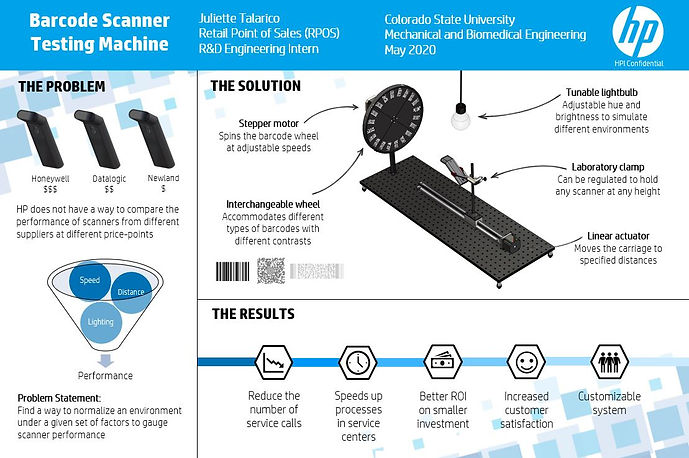
The Barcode Scanner Tester was the project I primarily worked on during my second summer at HP Inc. in Spring, TX. The manager on my team that is responsible for retail peripherals (all the items that are used alongside retail point of sales systems such as barcode scanners, receipt printers, etc.) challenged me to build a barcode scanner testing machine.
THE PROBLEM
The HP Retail Team has many different types of customers with a wide range of needs. In order to meet all these demands, three different scanners are offered at three different price points. These scanners look almost identical, however they each offer different features based on their cost. Although the specs of each scanner are known, there was no way to quantify their performance in comparison to each other. For this reason, it made it difficult for HP salespeople to recommend certain barcode scanners to customers who had specific needs. I defined performance as the speed the scanner is able to scan, the range of distances it can scan, and the environment (or lighting) that it can scan in as each of these elements contribute to the overall performance of the scanner. My job was to find a way to normalize an environment under a given set of factors to gauge the performance of each scanner in relation to each other.
THE SOLUTION
In order to solve this problem, I designed and built a device consisting of several different components that can be tuned to measure the performance of a barcode scanner. First, the scanner in question is fixed to the rod found in the center of the device using a laboratory clamp, which allows the height of the scanner to be adjusted. This rod sits on a linear actuator, which can be moved to any specified distance. The scanner is pointed at a wheel of barcodes, which is spun by a stepper motor, that can be programmed to spin at any desired rate. The wheel is interchangeable so that other wheels with different types of barcodes can be swapped in and tested. Lastly, the whole device sits in an enclosure (not shown), with a tunable light bulb shining over the system. The hue and brightness of the light can be adjusted to simulate different types of environments. To validate that the system was functional, I set up a simple pass/fail system in Excel so that when the barcode scanner is hooked up to the computer and the test is begun, it can be seen which barcodes were correctly scanned at a given set of parameters and which ones weren’t. Before my summer internship came to an end, I also wrote an instruction manual that detailed how to control the linear actuator and stepper motor so that my fellow coworkers could work with the device once I returned to school.

THE RESULTS
Since there had not been a device like this at HP yet, it was difficult for the HP Retail Team to make the best possible recommendations to customers based on their needs and the scope of the scanner. Because of this, there had been numerous calls made to service centers about HP scanners not working properly in the environments they were being used in. With the implementation of the Barcode Scanner Tester, it has allowed the team to determine minimum optimal parameters for each of these scanners and will help salespeople sell the scanner that is best suited for that specific customer. This will reduce the number of service calls, in turn speeding up other processes in service centers. Other key takeaways are that this device will provide a better return on investment for a smaller investment because scanners now only need to be tested using this machine. Customers will be more satisfied because the company will have suggested the best scanner for their needs on the first try. Lastly, the system is very customizable, and many different components can be adjusted if needed, giving the tester a lot of flexibility when testing. It was estimated that this device lead to a 50% reduction in testing time.